What is a digital twin
the faithful copy of your plant, kept up to date
A digital twin is the three-dimensional, faithful copy of a physical asset, kept up to date over time as that asset changes. In an industrial plant it is the BIM replica of what is built — structure, equipment and pipework — measured with a laser scanner and kept current.
Go straight to the specifics: examples of a digital twin in an industrial plant ↓
Digital twin: what it is, in detail
The term sounds futuristic, but the idea is concrete: a digital replica of something real, used to make decisions about that thing from the model, wherever you are.
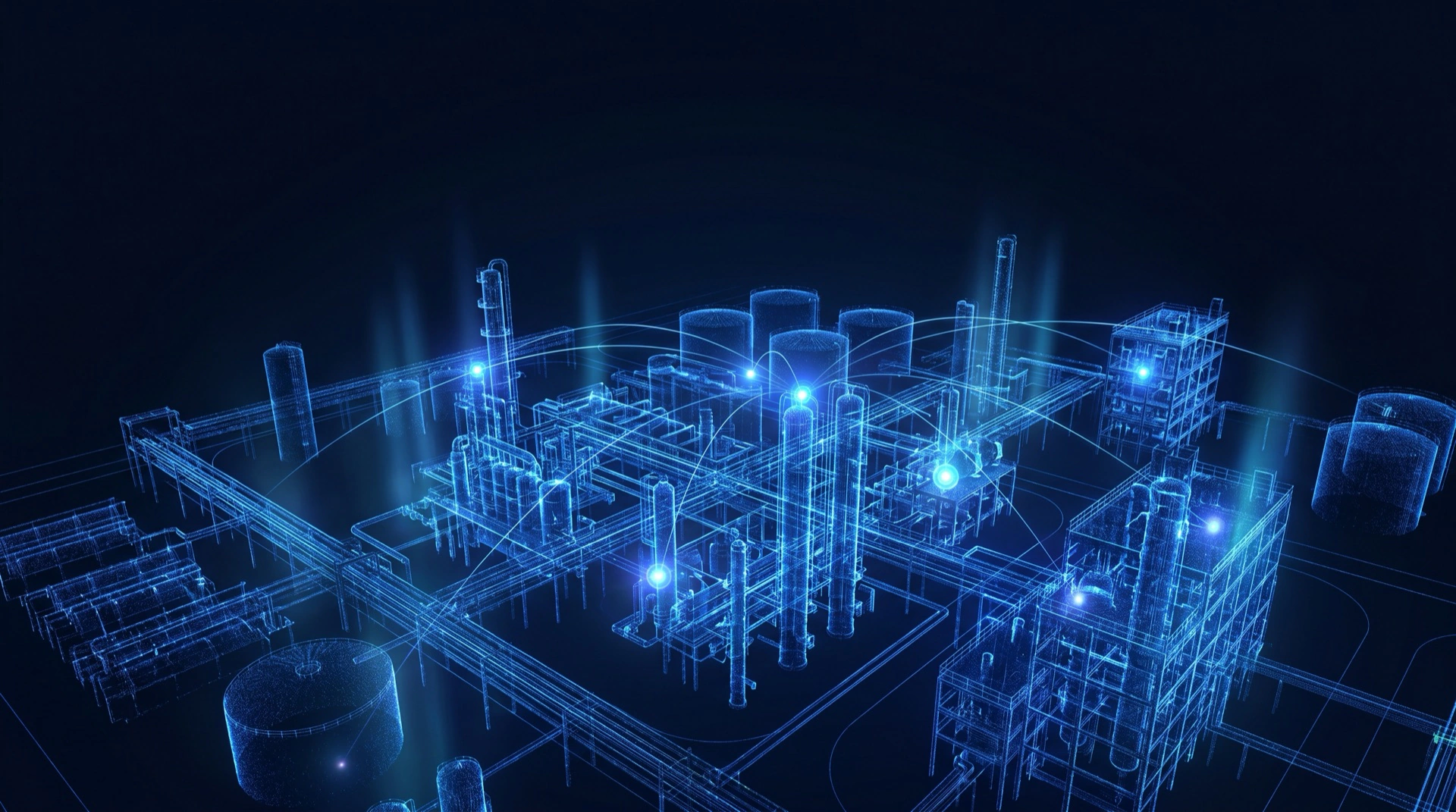
A digital twin is the digital copy of a physical asset: a machine, a building, an installation or an entire plant. In its most useful form, that copy is three-dimensional, built from real measurements, and reproduces the asset faithfully, element by element. More than an image, it is a model you can query: you can measure, isolate systems and check how each item fits.
That said, a digital twin has two halves, and both matter equally. The first is being faithful: reproducing the asset exactly as it is today, with every refurbishment and every replaced item of equipment already incorporated. The second is being up to date: keeping pace with the asset as it changes. An exact replica that nobody updates falls behind at the first intervention; and a model that is updated but starts from a theoretical drawing was never faithful. Only when both conditions are met is there a true twin.
A digital twin is the three-dimensional copy of a physical asset, faithful and kept up to date over time. It reproduces what exists today — not what was designed — and keeps pace with the asset as it changes.
Two different digital twins: assets and processes
Two different things coexist under the same name, answering different questions. Knowing which one you need clears up half the confusion around the term.
-
Asset twin · what A3D does The plant you can touch
The geometric copy of what is physical: structure, equipment and pipework, measured with a laser and modelled in BIM. It answers “how is my plant really built and what fits where?”. It is the basis for planning works, locating new lines and putting projects out to tender on the real condition.
-
Process twin The plant that flows and measures
The model fed by sensors: SCADA, telemetry, PID control and real-time flow and production simulation. It answers “how is my process behaving right now?”. It belongs to automation and process control, disciplines distinct from ours, and we say so plainly.
It is worth saying openly: A3D builds the as-built geometric twin of physical assets, that of the plant you can measure and touch. Sensors, telemetry and process simulation are the territory of other specialisms, and anyone looking for those will do well to approach them. Both twins coexist well — in fact, the geometric one is usually the base on which others build their data layers — but they are separate things.
On the name: “virtual twin” and “digital twin” are used as synonyms, as is “digital model”. The established term in engineering is digital twin, and what truly defines it is not the word but the two conditions — faithful and up to date — we have already seen.
The asset twin is the geometric copy of what is physical — what you can touch — measured with a laser and modelled in BIM. The process twin is the model fed by sensors. A3D builds the first.
A twin that is not maintained becomes an old photograph
Almost everything written about digital twins stops at the exact copy. But the exact copy is only half the job: the other half is time.
Imagine you have made the effort: the plant has been measured and modelled, and you have a digital twin that reproduces every item of equipment and every line precisely. The first intervention arrives — works, a replaced item of equipment, a new line — and nobody updates the model. By the second or third, the twin no longer matches the plant: it has become a photograph of how things were. Whoever decides on that photograph meets the surprises on site: clashes that had not shown up, dimensions that no longer add up, cost overruns and delays.
That is why maintenance is not an extra; it is part of the definition. A twin kept up to date is a source of confidence: you can decide on it knowing it reflects the real plant. And it is a source of truth: a single current version, the one that governs, for engineering, maintenance and purchasing. Keeping it up to date is what separates a digital twin from a handsome model that ages on a hard drive.
A twin has two halves: faithful and up to date. As soon as an intervention stops being reflected in the model, the twin starts to become an old photograph, and deciding on that photograph brings the surprises to site.
What a digital twin is used for: examples in a plant
The usefulness of the twin is best seen in concrete cases. These are real uses of an as-built digital twin in an industrial plant, described anonymously, as they appear day to day.
- Validate equipment before buying it Check on the model that the new machine gets through the door, fits its space and that its connections match what is there, before signing the order or moving the crane. An agri-food processing manufacturer worked out a complete layout on the twin this way, before ordering anything.
- Measure with production running Take exact dimensions of a section from the point cloud and the model, with the plant operating, instead of scheduling a shutdown or sending someone with a tape measure to a hard-to-reach area.
- Up-to-date drawings for maintenance The technician opens the model and finds today’s plant — not the drawing from twenty years ago — with every refurbishment incorporated. They locate the equipment, the valve or the section before going up to that elevation.
- Coordinate the contractors Several engineering firms and contractors working on a single model, each seeing what concerns them. Clashes between disciplines appear on screen, before they appear on site.
- Document management in one place As-built drawings, P&IDs and isometrics in a single environment and in their current version. The hunt for the latest version by email is over: whoever opens the model opens the truth of the plant.
- Put works out to tender Bidders start from the real, measured condition, not from an approximate description. Budgets come in tighter, and surprises — and the cost overruns that follow — stay out of the project.
- Detect clashes before the works Position a new line, a support or an anchor on the model and check that it does not clash with an existing pipe, cable tray or structure. The clash is resolved in the model, not with the works halted.
The common thread in all the examples: the decision is made on what really exists, measured, and not on a theoretical drawing that stopped matching the plant years ago.
How a digital twin is built
An as-built plant digital twin is built in three steps, from the physical world to the navigable model. None is skipped: the model is as good as the measurement it starts from.
-
3D laser scanning
A laser scanner is taken through the plant, with production running, capturing millions of points that record the real geometry of everything there: structure, equipment and pipework.
-
Point cloud
The scan produces a point cloud: a metric, navigable replica of the plant. It is already useful information in itself — you can measure and walk through it — before a single BIM model exists.
-
BIM modelling
The plant is modelled in BIM on the point cloud: each element is reconstructed as an object with data — a pipe, a tank, a beam — faithful to what was measured. The twin is delivered in RVT, NWD and IFC, ready to work with.
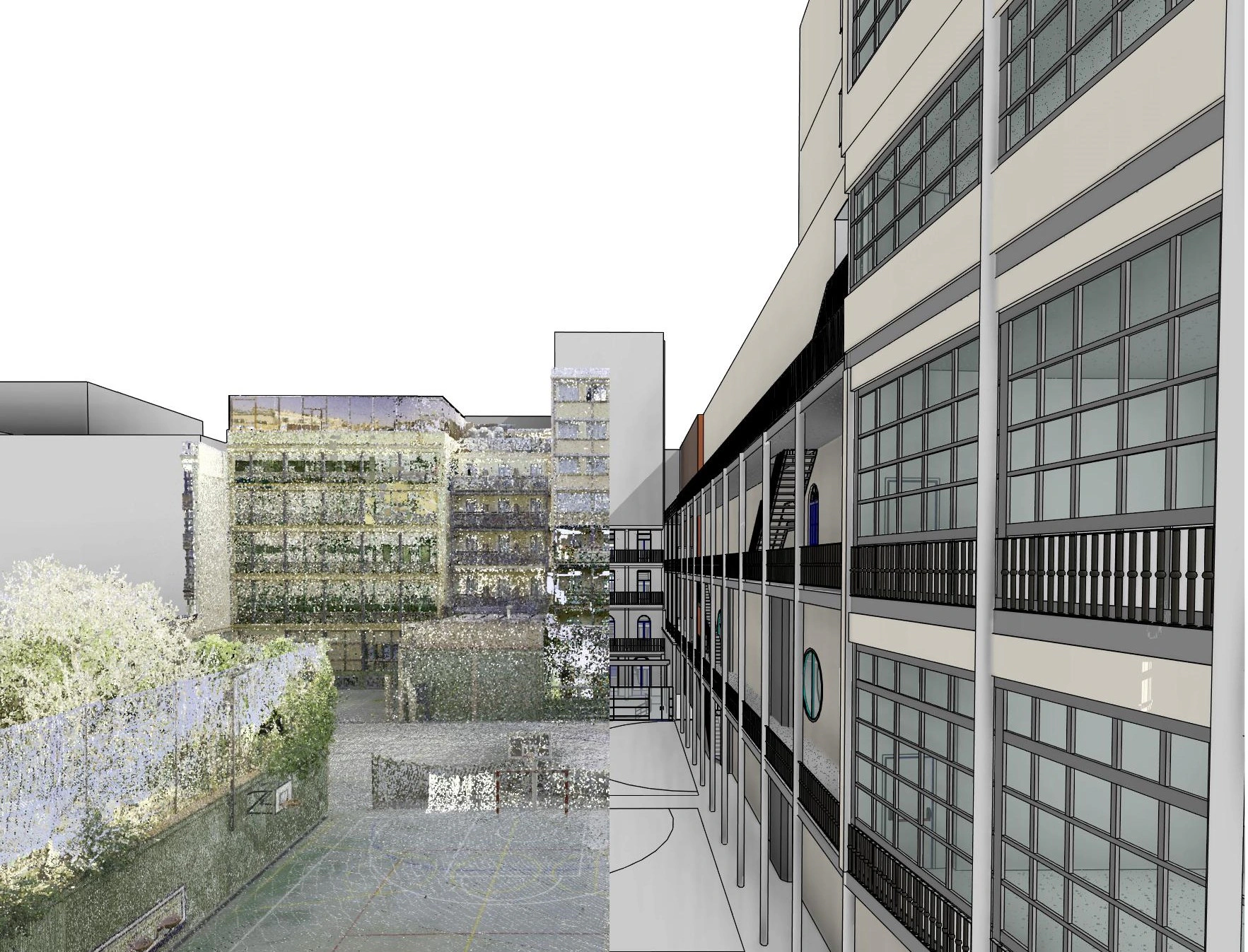
A plant digital twin is built in three steps: laser scanning → point cloud → BIM modelling. And, to remain a twin, it is kept up to date when the plant changes.
The digital twin and Industry 4.0
The digital twin is one of the pillars cited when discussing Industry 4.0, alongside the internet of things, data analytics and automation. The underlying idea is always the same: to have a digital replica of the asset on which to simulate, plan and decide, rather than doing so blind or relying only on the experience of someone who has been in the plant for years.
Within that framework, the earlier distinction returns: the Industry 4.0 discourse tends to focus on the data and process twin — the one that integrates real-time sensors — and that is fine. But beneath that layer a reliable geometry is needed: the as-built geometric twin of the physical plant is the base on which everything else rests. Starting with the faithful copy of what is built is, almost always, the sensible first step.
Frequently asked questions about the digital twin
Direct answers to the most common searches about “what is a digital twin”, with the judgement of those who build them every day.
What is a digital twin?
A digital twin is the three-dimensional, faithful copy of a physical asset, kept up to date as that asset changes. In industry it is the BIM replica of a plant as it is actually built — structure, equipment, pipework — measured with a laser scanner and carrying data per element. It has two halves: being faithful to what is built and being up to date over time; with both, it serves to measure, plan works and make decisions about the real plant.
Is a digital twin the same as a virtual twin?
In practice they are used as synonyms: “virtual twin” and “digital model” name the same idea of a replica of a real asset. The established term in engineering is digital twin, and its value rests on two conditions: that it is faithful to what exists and that it is kept up to date. An exact replica that nobody updates stops matching reality and loses half its usefulness.
What is the difference between an asset digital twin and a process digital twin?
The asset twin is the geometric copy of what you can touch — structure, equipment and pipework — measured with a laser and modelled in BIM. The process twin is the model fed by sensors: SCADA, telemetry, PID control and flow and production simulation. They answer different questions. A3D builds the as-built geometric twin of physical assets; sensors and process control belong to other disciplines.
What is a digital twin used for in an industrial plant?
It is used to make decisions about the real plant: validating that new equipment fits before buying it, taking exact dimensions with production running, giving maintenance teams drawings that match what is there, coordinating several contractors on a single model, keeping documentation in its current version and putting works out to tender on the basis of the real, measured condition. In every case, the decision is made on what exists, not on a drawing from twenty years ago.
What is a digital twin in Industry 4.0?
In Industry 4.0, the digital twin is one of the pillars: a digital replica of the asset on which to simulate, plan and decide. It helps to distinguish the data and process twin — the one that integrates real-time sensors — from the as-built geometric twin of physical assets. The second is the reliable base of the plant on which the others rest: without a faithful copy of what is built, any layer placed on top starts from the wrong geometry.
How is a digital twin of a plant built?
In three steps. First, the plant is scanned with a 3D laser scanner, with production running, capturing its real geometry. That scan produces a point cloud: a metric, navigable replica of what is there. On that point cloud the plant is modelled in BIM, reconstructing structures, equipment and pipework as objects with data, faithful to what was measured. The result is delivered in working formats — RVT, NWD and IFC — and, to remain a twin, it is kept up to date when the plant changes.
Want the underlying concept? Review what BIM is, the methodology used to model the twin. And if your question is more “what about my plant?”, the next section is for you.
If the plant is yours, the question changes
So far, the concept. If you have reached this page because your facility has been running for years and you wonder what a digital twin would do for it, the question is no longer what it is, but how your plant’s twin is made and how it is kept up to date. That is A3D’s work: measuring what is there, reconstructing the as-built twin faithful to reality and keeping it current as the plant changes.
A3D builds and keeps up to date the as-built digital twin of industrial plants that are already built, from laser scanning, faithful to the measured real condition.
Start with one area of your plant
You do not need to digitise the whole plant to have your first digital twin. Tell us what intervention you are planning — works, an equipment replacement, a tender — and A3D scans that area and delivers its as-built twin so you can validate before moving the crane. The twin kept up to date starts from around €400/month (estimated); the detail, by level, is on the service page.
Prefer to start with the underlying concept? Review what BIM is or see real cases by sector.